Why
hydrogen
matters
Limiting global warming to 1.5 °C (Paris Agreement) means cutting greenhouse gas emissions 45% below 2010 levels by 2030 and reaching net zero by 2050 (United Nations). Renewable and low-carbon hydrogen, emitting no CO₂ when used, can decarbonise hard-to-electrify sectors such as heavy industry and is expected to meet around 10% of EU energy needs by 2050 (European Commission).
Ammonia (NH₃) offers a practical way to transport hydrogen as each molecule contains three hydrogen atoms, which make up almost 18% of its mass. It can be stored as a liquid at around −33 °C at atmospheric pressure, or under moderate pressure at ambient temperature.
18%
OF AMMONIA'S MASS IS HYDROGEN
Thanks to this established global trade, ammonia can carry hydrogen over long distances using existing infrastructure, then be converted back into high-purity hydrogen where needed. Conventional cracking splits ammonia into hydrogen and nitrogen at high temperature, with purification and compression carried out in separate, energy-wasting steps that add cost and complexity.
COUPLE aims to make this conversion simpler and more efficient.
NH₃
CRACKED INTO HYDROGEN AND NITROGEN
The barriers
to overcome
Current ammonia-to-hydrogen technologies face three major barriers:
-
Limited energy efficiency
Multi-stage conversion and separation processes lose energy along the way.
-
Poor performance at small and medium scale
Existing technologies are designed for large, centralised plants and perform worse when scaled down.
-
High uncertainty for industrial investment and deployment
Industry needs technologies that are demonstrated and financially viable.
Two membranes,
one process
COUPLE integrates ammonia cracking, hydrogen separation, compression and heat management into a single, continuous process.
At its core are two complementary membrane reactors:
-
PdMR
Palladium membrane reactor
A highly selective filter that lets only hydrogen pass through
-
PCER
Proton ceramic electrochemical reactor
It uses electricity to extract and compress the remaining hydrogen while generating heat for the cracking reaction
Inside COUPLE
-
The process
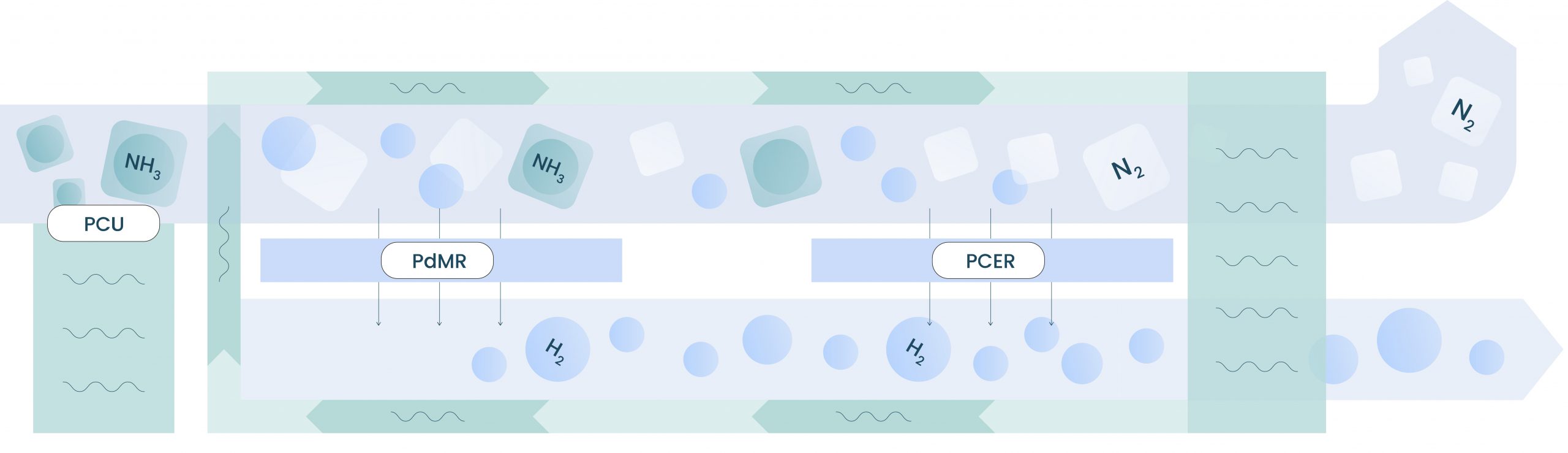
The COUPLE process can be followed step by step, from ammonia to high-purity, pressurised hydrogen
-
The process
The COUPLE process can be followed step by step, from ammonia to high-purity, pressurised hydrogen
-
Initial cracking
In the primary catalyst unit (PCU), ammonia is partially split into hydrogen and nitrogen.
-
Hydrogen separation
In the palladium membrane reactor (PdMR), cracking continues while the membrane extracts around approximately 60% of the hydrogen.
-
Final conversion and recovery
The proton ceramic electrochemical reactor (PCER) converts the last traces of ammonia while extracting and compressing the remaining hydrogen, bringing total recovery above 95%.
-
Heat integration
Unlike conventional processes, which burn part of the fuel to supply heat, COUPLE sends the heat produced by the PCER back to the PCU, creating an energy efficient heat loop.